

OUR MISSON: Preserving the Place Where South Carolina Governed During the Civil War
On November 1, 2023, Preservation South Carolina took ownership of the Dawkins House in Union, SC. It is our intent to work with the community and corporate leaders to stabilize the house and prepare it for its future role as a Corporate and Alumni Center on the campus of USC-Union. Once restored, Preservation South Carolina will convey ownership to USC -Union which will be its long-steward.
Community Partners


“Due to its significant and unique contribution to South Carolina’s history, the Dawkins House should be preserved and restored for functional use and study by current and future generations,” - Bill Comer, Preservation South Carolina Board.
A collaborative effort by Preservation South Carolina, the Union–Laurens Commission for Higher Education, the University of South Carolina – Union, and Timken Corporation, to preserve and restore the Dawkins House - one of South Carolina’s most significant, but little known, historical landmarks.

History
Learn about the Dawkins House & Its Restoration
The Dawkins House in Union, South Carolina, holds extraordinary historical significance for Union and the State of SC.
Besides the State House in Columbia, the Dawkins House is the only still-standing building to ever serve SC as its state capitol building.
Support
From Porch to Parlor, Make Your Mark on the Dawkins House
Partners including Preservation South Carolina, Union–Laurens Commission for Higher Education, University of South Carolina Union, and Timken Company are working together to ensure this landmark is preserved for future generations.
Naming Opportunities
Premier Corporate & Individual Leadership Opportunities
The Dawkins House Preservation Campaign is structured to encourage broad participation while recognizing premier corporate and individual partners whose leadership commitments play a transformative role in the preservation and restoration of one of South Carolina’s most historically significant landmarks.
Judge Thomas N. Dawkins House
("The Shrubs")

History
Located at the end of N. Church Street in downtown Union is an unassuming building that does not outwardly show its history as the one-time state capital of South Carolina during the Civil War.
When Judge Dawkins built his house in 1845 with Federal and Georgian architectural attributes, it was added onto a pre-existing structure. Today, the house is 4,500+ square-feet located adjacent to the University of South Carolina-Union campus. It is also a “terminus” home in that it is located and its front door is at the end of N. Church Street, which connects to Highway 176, the main route from Union to Columbia.
The Dawkins House is most notably regarded as the former home of Judge Thomas N. Dawkins and his second wife, Mary Poulton Dawkins. Initially named "the Shrubs" after Mary Poulton's childhood home in England, this two-story, clapboard building has five bedrooms, two parlors, and eight fireplaces.
Portions of the pre-existing structure are estimated to date back to 1765, making it one of Union’s oldest surviving homes that witnessed events of the Revolutionary War era and the Presidencies of George Washington and John Adams. The original 1700’s structure remains intact and has exposed beams with carved end fittings and bead-cut edges that can be easily seen inside from the house. Some of the building materials match those of the historic Walnut Grove Plantation in Spartanburg County, SC, built in 1765. The entire house is supported by chiseled granite foundation blocks, has decorative crown molding, and once had a floating spiral staircase in the mail hall that will be re-built.


Judge Thomas Dawkins and his wife, Mary Poulton Dawkins

Bennett Preservation Engineering Assessment November 2023
South Carolina played a pivotal role in the Nullification Crisis of the early 1830s. On November 24, 1832, the state legislature passed the “South Carolina Ordinance of Nullification,” rejecting federal tariffs that disproportionately benefited Northern industries while economically harming Southern agrarian states. The South had not developed the industrial infrastructure of New England, and thus Southern planters depended on foreign imports. As a young lawyer, Judge Dawkins stood in the minority as a Unionist, opposing the Nullification movement. Despite his differing views from his peers, Dawkins earned widespread respect for his integrity and leadership, securing election to the South Carolina House of Representatives from Union County, where he served from 1838 to 1839 and later from 1862 to 1866.
On December 18, 1864, Andrew G. Magrath was elected Governor of South Carolina, serving from December 20, 1864, to May 25, 1865. Magrath and Judge Dawkins attended South Carolina College (now the University of South Carolina) together in the late 1820’s and early 1830’s. On February 16, 1865, Magrath evacuated and fled the Capitol City of Columbia one day before it surrendered to General Tecumseh Sherman whose troops occupied and burned the city. Forced to move the state government to temporary headquarters, Magrath contacted his friend, Judge Dawkins,
From February to April 1865, the Dawkins House served as South Carolina’s Provisional Capital. As such, Union has the distinction of being only one of four cities to serve as South Carolina’s state capitol, the others being Columbia, Charleston, and Jacksonboro.

Main Street North from the State House after General Sherman's visit in 1865 from Digital Collection: Standard Federal (Columbia S.C.) Photograph Collection

After the Civil War, Judge Dawkins played a significant role in rebuilding South Carolina. He was a member of the state convention for reorganizing the government and chaired the judiciary committee in the South Carolina House of Representatives in 1866.
Beyond politics, Dawkins and his wife were deeply involved in their community. Together, they founded the Episcopal Church of the Nativity in Union in 1855, which was added to the National Register of Historic Places in 1974 and remains active to this day. Judge Dawkins passed away in the house in 1870, and his wife, Mary Poulton Dawkins, passed away in the house in 1906.
Emergency Stabilization
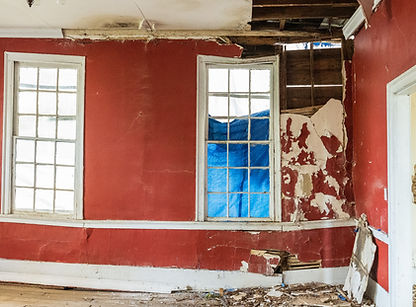
On April 10, 2024 engineers from Bennett Preservation Engineering, PE were on site to examine the structure and determine a scope-of-work for its stabilization.
The most evident conclusion about the condition of the structure is that it has seen considerable deterioration as a result of prolonged water intrusion. The building is not, however, beyond repair. The building can be shored, the severely deteriorated framing sistered or replaced, and the masonry reconstructed where necessary. While this will involve considerable work, this structure, which served as the seat of government for South Carolina as Columbia burned, holds an extensive history and is particularly valuable for the events that transpired here.
In January 2025, we commenced the stabilization of the home, following a thorough examination of the structure's condition and receipt of a stabilization report from Bennett Preservation Engineering. We look forward to collaborating with Huss Construction on this significant first phase and continuing our partnership with Bennett Preservation Engineering.
The result of this phase will be a structurally sound building ready for final rehabilitation work, accurate measured and construction drawings, and a vision and plan to manage the Dawkins House.



Support The Dawkins House Preservation Campaign

Through generations, the Dawkins House has borne witness to the people, stories, traditions, events, and craftsmanship that shaped our state and the nation. Today, through the Dawkins House Preservation Campaign, we have a remarkable opportunity to restore this irreplaceable landmark and ensure its legacy continues for generations to come.
Adopt a Piece of History
Through our Adopt-a-Feature Program, individuals and organizations can directly support the restoration of specific architectural elements—from the grand staircase to historic windows, from porches to interior spaces.
Every contribution makes a tangible impact!
-
Sponsor a chimney brick for just $50 and leave a permanent mark on this historic home
-
Restore a window and preserve the craftsmanship of the past
-
Support the roof and help protect the structure for years to come
-
Sponsor a room or defining feature and leave a lasting legacy
Several opportunities have already been claimed, including the Front Porch and Side Porch, and others are quickly filling.
Restoration Opportunities
Major Structural & Architectural Elements

Featured Spaces & Porches

Get Involved
To reserve a naming opportunity or learn more about supporting the campaign, please contact:
Annie Smith
University of South Carolina – Union
📞 864-979-1818
“Willie and Mary Jeffries’ Commons at Dawkins House.”

To recognize the extraordinary, lifelong contributions of Coach Willie Jeffries and Mrs. Mary Jeffries—natives of Union and nearby Lancaster—Preservation SC and the Union-Laurens Commission for Higher Education have announced a meaningful new chapter for this historic landmark. The restored Dawkins House will be formally named “The Willie and Mary Jeffries Commons at Dawkins House.”
This designation celebrates a legacy defined by character, leadership, and impact. Willie and Mary Jeffries embody values that continue to inspire students, educators, and business leaders alike:
-
A spirit of drive and perseverance—rising from humble beginnings to break barriers in academics, athletics, and life with grace and dignity
-
A deep commitment to education, youth, and community service
-
Leadership grounded in humility, loyalty, and gratitude
-
A passion for mentorship, creating opportunities and lifting others along the way
Importantly, this new name does not replace the historic identity of the Dawkins House. Rather, it introduces a functional name that reflects the building’s renewed purpose, while preserving its historic significance for generations to come.
The term “Commons” reflects a shared and vibrant space—one designed to bring people together. Located on the USC Union campus, the Commons will serve as a hub for connection and collaboration, where students, faculty, and corporate partners can gather for networking, professional development, meetings, and special events. It will be a place where ideas are exchanged, partnerships are formed, and innovation is fostered.
The story of Willie and Mary Jeffries aligns with the vision of this project: to honor the past while inspiring the future. As the Dawkins House enters this new era, it stands not only as a preserved historic structure, but as a dynamic space where the next generation of leaders will be shaped.
In The News
Explore Preservation SC's Dawkins House Project through a collection of publications.


Project Partners
University of South Carolina Union
City of Union
Union County
Bennett Preservation Engineering, PE
Huss Construction